Showing posts with label Maple Sugaring. Show all posts

March 29, 2025

Hitty Makes Pancakes with Little Bear!

Maple Sugaring, A Family Tradition!

Hitty makes pancakes on the old wood cookstove. The little bear looks on with eager anticipation!


An Ancestral Old New England House!

My great great great grandmother's great grandparent's old house in Rhode Island. I love this house with its wonderful stone walls and maple trees! It was my 6th great grandfather's house.
Buckets are hung on the old maple tree for collecting sap.


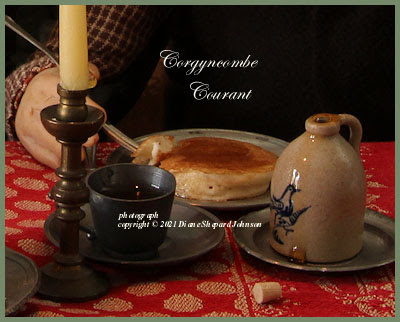
Hitty and Little Bear enjoy their pancakes with goat's milk.
Real Maple syrup is in the bird jug.


Little Bear likes sticky things, honey and maple syrup are favorites! Yum!
Little Bear has been a well loved little bear. He is worn and is missing an ear but all the dolls at Corgyncombe think he is adorable!


Maple Sugar


At the Corgyncombe Forget-Me-Not Fair, pancakes, maple syrup, old fashioned doughnuts and apple cider can be found at Hitty Maple's booth.


Quackenbush excitedly quacks and flaps his wings and hops atop the bench and indicates that pancakes and doughnuts are amongst his favorite things! He is so happy to bring Dilley Dibble Dabble to visit this booth!

 
Quackenbush and Dilley Dibble Dabble have been featured at the Corgyncombe Courant for years. 

  
The pancakes are made right in the booth on an old wood cookstove.


What a pleasant sight it is to see the old buckets hung on the maple trees!


With the coming of spring, with freezing nights and warming days, the sap in the old sturdy maple trees starts its journey up the trees. For generations my family has harvested the sweetness of the maple tree. When I was a little girl I remember peeking into my grandfather's sugar house at night to see my grandfather and uncles tending the fires and skimming the foam from boiling sap pan.


Maple sugaring is a tradition in my family!


Some of the photographs and some of the writings on this post are from previous Corgyncombe Courant posts that can be found here on the Corgyncombe Courant and from our web site and our previous postings elsewhere on the internet.


Please do not "Pin" our photographs.
Please do not post our photographs on facebook.


Our email:
atthecottagegate@yahoo.com
If you receive an email you think is from me from this email, please make sure it is atthecottagegate@yahoo.com, and not just something that sounds similar.


Photographs, images, and text copyright © 2000-2025 Diane Shepard Johnson and Sarah E. Johnson.
All rights reserved. Photographs, images, and/or text may not be reproduced in any form without permission in writing from Diane Shepard Johnson and Sarah E. Johnson.


https://corgyncombecourant.blogspot.com/2025/03/hitty-makes-pancakes-with-little-bear.html
copyright © 2025 Diane Shepard Johnson and Sarah E. Johnson

~~~~~~~~~~~~~~~~~~

March 20, 2024

Tasha Tudor's Historic New Hampshire Farm, The Old Gerrish Homestead!

The Old Gerrish Homestead!

In "Drawn from New England" Bethany Tudor wrote about how her mother, Tasha Tudor, found a delightful old house and farm in New Hampshire. Even though the house was in disrepair Tasha could see beyond it and her artist's eye could see how wonderful it could be! Tasha bought the old house and farm from an old man named Ed Gerrish in 1945. Ed Gerrish's great grandfather Moses Gerrish built the house about 1789. I was thrilled to discover that the Gerrish family that built and owned the New Hampshire house and farm was related to me!


The old photograph shows the Gerrish Homestead (built about 1789 by Moses Gerrish) in about 1869. The house was later owned by Tasha Tudor. Ed Gerrish was born in 1867. Perhaps he could be the little child in the photo standing by his mother. Photograph courtesy of the Webster Historical Society.


Moses Gerrish's father Col. Henry Gerrish was 2nd cousin to my 6th great grandfather John Hale. Both Henry and John served in the Revolutionary War. Col. Henry Gerrish and John Hale were first cousin and second cousin, respectively, to Nathan Hale the great American patriot.


We found that Moses Gerrish's grandmother was Joanna (Hale) Gerrish. 'Tis no surprise that her name would have been Joanna! In my branch it is a well known Hale family name. The first Hale of the line in New England was Robert Hale and his wife was Joanna. The name Joanna appeared in every generation of Hales down the line in my family (except for one generation which only had sons). Each generation of Hales had a sister Joanna. Nathan Hale, too, had a sister named Joanna.


Tasha Tudor encouraged my daughter and I in our genealogical pursuits and she wrote to us:

"That fine red envelope full of photographs and the pages of Family names, was no end impressive."


"Have fun with your genealogical researches. What fun!!"
 
 
The house built by Moses Gerrish about 1789 was lived in by several generations of the Gerrish family, including Moses' grandsons: brothers Henry H. Gerrish and James L. Gerrish. Henry and James both had wives named Sarah, who were referred to in a written family history as "Sarah Henry" and "Sarah James", to note which Sarah was being spoken of. They all lived in the old Gerrish house. James Gerrish was the father of Ed Gerrish who later sold the farm to Tasha Tudor in 1945.


James Gerrish served for the Union during the Civil War as part of the New Hampshire Volunteers. Tasha Tudor's dolls Captain Shakespeare and Lieut. Thaddeus Crane both also served in the New Hampshire Volunteers. The wedding of Lieut. Thaddeus Crane and lovely Melissa was held at the old Gerrish house and was featured in "Life" Magazine. Melissa was Tasha Tudor's model for the doll in "A is for Annabelle".

James Gerrish was engaged to Sarah Chandler just before he left for service in the Civil War. They were then married in 1864.


James Gerrish's daughter wrote about how although his responsibilities to care for his family as a farmer meant perhaps he could not pursue another career, he was artistically inclined and he appreciated and found beauty in his life. He raised dairy cows and sheep. He built stone walls. Whilst he was doing work about the farm James made up poems for his daughter. He planted a row a mile and a quarter long of maple trees by the road for tapping and for the pleasure to the senses. He thought this would be a long lasting remembrance of him after he was gone. I remember even as a child appreciating rows of big old maple trees along both sides of the road and also old stone walls, how special!


James Gerrish's brother Henry H. Gerrish's wrote diaries in which he described work and happenings about the farm. In reading them, one can see that they collected sap and did maple sugaring, attended sugaring parties, harvested their own ice and packed it in sawdust, did haying, grew apples, potatoes and other crops, as well as many of the old fashioned tasks that my families also did.


It is interesting to see the perspective from the previous generations' experiences in the same house that Tasha Tudor lived in and experienced some of the same things, too.


James L. Gerrish's daughter Mabel (Ed's sister) wrote down her recollections and stories of the farm and her family.


One can follow through Tasha Tudor's Around the Year and other books and illustrations and see similarities. Tasha Tudor drew many things done on the farm in previous days. "Becky's Birthday", "Becky's Christmas", "Adventures of a Beagle", and "Biggity Bantam" all have Tasha's illustrations of the New Hampshire farm.


Mabel wrote of coming home from school to her mother's "cozy kitchen" through the pantry, which was filled with wonderful things to eat such as pie, doughnuts, cake or cookies. Her description makes me think of Tasha Tudor's detailed illustrations of the pantry and butt'ry with the many things stored there.


Mabel also mentioned that raspberries and blueberries were picked on the farm and made into pies. In Around the Year folks are shown picking berries and having a picnic in July with a pie in the border.


Mabel wrote that her aunt visited her mother's kitchen especially during the time that the peaches were ripe. Around the Year shows a busy kitchen with the ladies putting up peaches.


One year at Thanksgiving when the Gerrishes had many relatives there for dinner in the old kitchen, there was a big snowstorm and some folks had to stay overnight. Mabel spoke highly of the pumpkin pies that were made in the brick oven. During part of the party the children dressed up in old fashioned clothes.


Mabel enjoyed coasting and skating in the winter. Each year a different family in the school district would have a large Christmas tree and everyone would come to the party with gifts, there would music and treats. In Around the Year Tasha Tudor, of course, featured coasting, skating, and a family gathered around the Christmas tree.


Mabel fondly remembered the attic and mentioned some of the old things found there: spinning wheels, cheese presses, old foot stoves, and the big wooden loom. Also in the attic were items related to fashions of the past: hoop skirts and "Godey's Lady's Book" fashion magazines. Perhaps some were of the same time and style as Tasha Tudor's illustrations in the miniature fashion magazines and catalogs that she made for the dolls and critters. The old things in the attic sound like things that Tasha and I would both get excited about!


Tasha Tudor delighted, as we do, in refined, simple elegance, in a country way, and the combining of the every day old fashioned tasks as our ancestors did, with artistic skill that could be seen by the beauty in their accomplished results... such as baskets, clothing, gardens, pottery, textiles, furniture, food preparation, architecture, and even their tools.


Mabel learned to read from her mother and her older college aged brother Ed. When one of Ed's professors came to visit the Gerrishes, he saw that Mabel, a little girl at the time, was reading books that he considered advanced for her age, he sent her the book "Mother Goose". Mabel cherished this "Mother Goose" for many years to come! Later, Tasha Tudor illustrated her version of "Mother Goose" (1944) and used the money she made from it to buy the old Gerrish home.


Henry H. Gerrish's diaries and Mabel (Gerrish) Page's stories can be found at the Webster Historical Society.
Photograph of the Gerrish homestead about 1869 courtesy of the Webster Historical Society.


Some of the photographs and some of the writings on this post are from previous Corgyncombe Courant posts that can be found here on the Corgyncombe Courant and from our web site and our previous postings elsewhere on the internet.


Please do not "Pin" our photographs.
Please do not post our photographs on facebook.


Our email:
atthecottagegate@yahoo.com
If you receive an email you think is from me from this email, please make sure it is atthecottagegate@yahoo.com, and not just something that sounds similar.


Photographs, images, and text copyright © 2000-2024 Diane Shepard Johnson and Sarah E. Johnson.
All rights reserved. Photographs, images, and/or text may not be reproduced in any form without permission in writing from Diane Shepard Johnson and Sarah E. Johnson.


http://corgyncombecourant.blogspot.com/2024/03/tasha-tudors-historic-new-hampshire.html
copyright © 2024 Diane Shepard Johnson and Sarah E. Johnson
~~~~~~~~~~~~~~~~~~

March 30, 2021

Maple Sugaring, A Family Tradition!

Tasha Makes Pancakes for Natty and Baby!


Tasha making pancakes on the "Little Fanny" stove.

Click Here for Lovely Music


An Ancestral Old New England House!

My great great great grandmother's great grandparent's old house in Rhode Island. I love this house with its wonderful stone walls and maple trees! It was my 6th great grandfather's house.
Buckets are hung on the old maple tree for collecting sap.


I painted the pussy willows around my photograph of Sarah collecting sap with Tasha Corgi.
Tasha Tudor loved it!

Tasha Corgi was named after Tasha Tudor, and Tasha Tudor was very honored and declared herself to be Tasha Corgi's Godmother.

What Tasha has drawn in her illustrations are the same old ways that I grew up with. I find them familiar, comforting, and I am drawn to them. [*See note below.]


Natty and the baby sitting by the wood cookstove waiting as Tasha makes pancakes.


We have included some Agricultural statistics from 1850 to 1880, showing the maple sugar and maple molasses production of my direct line ancestors' farms.

What hard work maple sugaring was, with collecting the sap, chopping the wood, tending the fires and the sap pans.


With the coming of spring, with freezing nights and warming days, the sap in the old sturdy maple trees starts its journey up the trees. For generations my family has harvested the sweetness of the maple tree. When I was a little girl I remember peeking into my grandfather's sugar house at night to see my grandfather and uncles tending the fires and skimming the foam from boiling sap pan.

Maple sugaring is a tradition in my family!


My father built this temporary simple sugaring hut. During sugaring season your sugaring hut gets to feel like home.

My father and I continued the tradition by making maple syrup. We constructed a small sugaring hut, a simple shelter from the elements. Many days and nights of dedicated work brought forth delicious gold from the maple trees. Once you have partaken in the old fashioned task of maple sugaring you can sense in the warming of the weather that the sap is running and the urge to commence sugaring is irresistible!

The tradition has been carried down further as I have done maple sugaring with my own family.


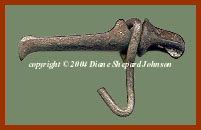
Some of the spiles that my family have used through the years.
The top spile has a patent date of 1877.

"After the hole has been bored, a small trough or "spile," as the country people call it, is inserted."
~ "Rural Hours", published 1850,
by Susan Fenimore Cooper


Sarah peeks under the bucket lid to find some of the sap had frozen. Although rusty on the outside, inside the buckets are clean and shiny.

It is so nice to be out in the coming of spring collecting sap, tending fires, and seeing and hearing the birds! When Sarah was little, her friends came over to help and experience the art of maple sugaring as they helped bore holes for spiles. With spoons the girls tasted the sap as it came out of the tree. I explained to Sarah's friends though the sap was clear and tasteless now, when boiled and evaporated down it would become a thickened maple syrup.


"Saturday, April 1st. - Fresh maple sugar offered for sale today; it is seldom brought to market as early as this. A large amount of this sugar is still made in our neighborhood, chiefly for home consumption on the farms.
With our farmers, however, it is a matter of regular household consumption, many families depending on it altogether, keeping only a little white sugar for sickness; and it is said that children have often grown up in this county without tasting any but maple sugar. Maple molasses is also very much used, some persons preferring it to that of the cane, as it has a peculiar flavor which is liked with puddings, or buckwheat cakes."
~ "Rural Hours", published 1850,
by Susan Fenimore Cooper


Maple syrup, a gift from a friend.


We are researching the possibility that my 3rd great grandfather Michael Yager was related through old family lines to Susan Fenimore Cooper.


We held a party where we finished off a batch of syrup on our old cook range. After straining the syrup, Sarah and her friends made their own pancakes on the old wood cook stove and they were enjoyed with the delicious homemade maple syrup. It is very satisfying to make your own maple syrup!


"A hole is first bored into the trunk, from one to three feet from the ground; a hatchet or chisel is sometimes used for this purpose, but neat farmers prefer a small auger, less than half an inch in diameter, by which means the bark is not injured, closing again over the opening in two or three years.
After the hole has been bored, a small trough or "spile," as the country people call it, is inserted; this is usually made of a branch of alder or sumach, which is sharpened at one end and the pith taken out for two or three inches to receive the sap; from that point it is hollowed into an open trough, which rests upon the sap-bucket at the foot of the tree.
They are left standing one at the foot of each tree, to receive the sap as it flows, the little stream of sweet and limpid fluid running more or less freely, according to the state of the weather and the character of the tree.
The buckets are watched, of course, and emptied from time to time, the sap being carried to the boiler, which is often placed over a furnace upon an arch of bricks; often one large iron boiler is used, but pans of tin are thought preferable, as they give less color and taste to the sugar. This carrying the sap to the boiler is a laborious part of the process."
~ "Rural Hours", published 1850,
by Susan Fenimore Cooper


My ancestors were descendants of early New England families.


Tasha settles baby into the chair that she does her artwork in, and puts a pillow under baby to bring her up to the table.


Baby thinks little Bear wants pancakes, too!


Maple sugar


Grandfather's House with Maple Trees and Stone Walls Round!


As the daylight was fading, the candles were lit.


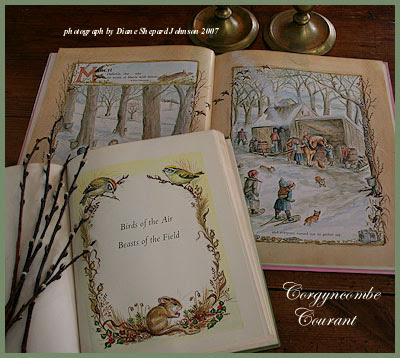
In March the library at Corgyncombe displays some of Tasha Tudor's March delights. In "A Time to Keep" Tasha Tudor illustrates a sap house and sugar bush with a family partaking in the annual tradition of gathering sap. Pussy willows and red-winged blackbirds surround the drawings. I love to hear the red-winged blackbird, it reminds me that spring is coming.  The book in the foreground, with the birds perched on pussy willows and the mouse, is "Wings from the Wind", a collection of poetry.


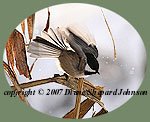
Red-winged blackbird.

"Two or three hundred trees are frequently tapped in the same wood, and as the sap is running, the fires are burning, and the sugar is boiling all together, day and night, it is a busy moment at the "bush." The persons at work there, usually eat and sleep on the spot until their task is done; and it is a favorite rallying place with the children and young people of the farms, who enjoy vastly this touch of camp life, to say nothing of the new sugar, and a draught of fresh sap now and then."
~ "Rural Hours", published 1850,
by Susan Fenimore Cooper


This delightful old family house looks like a Tasha Tudor illustration!


Baby has her spoon at the ready for enjoying the delicious pancakes and maple syrup.
Tasha has cut the pancakes up for baby.


"Around the Year" is another of our favorite Tasha Tudor books that illustrates the tasks and celebrations around the year. There is also maple sugaring in "Around the Year" by Tasha Tudor.
On the cover Tasha has drawn the farmers gathering the sap with oxen and sled.


Delicious maple syrup is in the jug!


What a pleasant sight it is to see the old buckets hung on the maple trees!
So much more delightful than the horrid, modern tubing that you see running from tree to tree in modern operations!


Seth bringing in a load of wood to keep his chilled cousin Lucy, who had just arrived at Corgyncombe on the heels of a nor'easter, warm.
Tillie Tinkham, the seamstress mouse at Corgyncombe, made Seth's red and black buffalo plaid coat.


Daisy has let Lucy borrow her dress & bow and Violet has let her borrow her warm socks. Daisy has hot chocolate and potatoes on the stove and Seth keeps bringing more wood to keep his cousin Lucy warm. She loves it at Corgyncombe!


Domestic and darling Daisy came to live with her cousins at Corgyncombe. With her she brought her delightful little stove, also called Daisy. Auntie Nicey replaced a window pane with a piece of tin with a hole in it for the stove pipe. Whilst making pancakes, Daisy enjoys the view of the Corgyncombe valley and the rolling hills beyond. Daisy is wearing a lovely frock and apron made by Tillie Tinkham, the seamstress mouse for the dolls at Corgyncombe, of "Tillie Tinkham's Frocks and Fashions". Like Daisy in cousin Louisa May Alcott's "Little Men", domestic and darling Daisy loves her little stove!


At the Corgyncombe Forget-Me-Not Fair, Hitty Maple's Booth sold pancakes, maple syrup, old fashioned doughnuts and apple cider.

Quackenbush excitedly quacks and flaps his wings and hops atop the bench and indicates that pancakes and doughnuts are amongst his favorite things! He is so happy to bring Dilley Dibble Dabble to visit this booth! Quackenbush and Dilley Dibble Dabble have been featured at the Corgyncombe Courant for years.


Hitty Maple makes the pancakes on the old cookstove, the "Ark", which was brought in from Nanny Nettie-Kin's kitchen. There is a pancake on the griddle that just about needs flipping over!


There are many jugs full of delicious Corgyncombe Maple Syrup for Hitty Maple's customers to put on their pancakes and also buy to take home.

I (Diane) remember fondly, many years ago, two elderly widow ladies Alice and Beulah who made and sold the best doughnuts! Their shop was on the corner with red and white check curtains at the window and red and white check decorating their shop. I can still see them making doughnuts in their pretty aprons and frocks! Such a warm and comforting memory!


Quackenbush says he will tell all his dearest friends about Hitty Maple's Pancakes, Maple Syrup,  Doughnuts, and Apple Cider!

As Tasha Tudor would say, "What Fun!"


* I wrote the sentences below originally in June 2007 in a letter to Julie:
"What Tasha has drawn in her illustrations are the same old ways that I grew up with. I find them familiar, comforting, and I am drawn to them."


Some of the photographs and some of the writings on this post are from previous Corgyncombe Courant posts that can be found here on the Corgyncombe Courant and from our web site and our previous postings elsewhere on the internet.


Please do not "Pin" our photographs.
Please do not post our photographs on facebook.


Our email:
atthecottagegate@yahoo.com
If you receive an email you think is from me from this email, please make sure it is atthecottagegate@yahoo.com, and not just something that sounds similar.


Photographs, images, and text copyright © 2000-2021 Diane Shepard Johnson and Sarah E. Johnson. All rights reserved. Photographs, images, and/or text may not be reproduced in any form without permission in writing from Diane Shepard Johnson and Sarah E. Johnson.


http://corgyncombecourant.blogspot.com/2021/03/maple-sugaring-family-tradition.html
copyright © 2021 Diane Shepard Johnson and Sarah E. Johnson
~~~~~~~~~~~~~~~~~~~~